
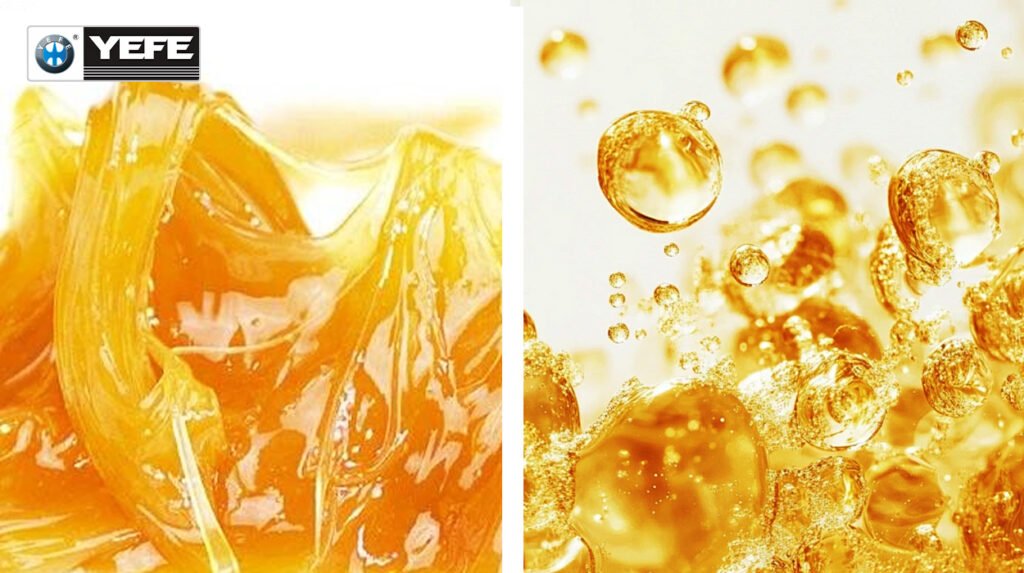
Grease is all fatty oil, which is also not true and this is a myth espoused by many. Grease and oil are quite different lubrication systems that are built on completely different grounds. Grease is made to remain in situ and offer permanent retention whereas oil is stipulated to flow, circulate and conduct away the heat. One should not confuse grease and oil solely in terms of viscosity, but rather the performance of both lubricants in real operating environments in terms of how they remain in place, resist and clear components.
Grease is chosen in case of the need to retain the lubricant and seal it, whereas oil is chosen in case of constant circulation and heat transfer. Making the wrong selection may result in insufficient protection, excessive wear, leakage or even disastrous failure of the bearings, gears, or other key parts.
What Is Grease and How Does It Lubricate?
Grease is a semi-solid lubricant and it contains the oil until it is released allowing mechanical pressure to act upon it.
Grease is made up of three dominant components, namely: a base oil (which can be 70-90 percent of a formulation), a thickener (lithium, calcium, or complex soaps), or performance additives. The heavy grease is made semi-solid by the thickener, making what otherwise would be liquid, a substance that does not submit to the actions of gravity, vibration, and centrifugal forces.
The thickener structure breaks temporarily under shear or pressure – i.e. when a bearing is in rotation – to permit an ordered discharge of the base oil to form a lubricating film. As soon as the stress is removed, the structure reforms, entraping the oil and making it unable to drain away. This renders grease the kind of lubricant that is ideal in those applications where the lubricant needs to be at the point of touch during the idle days, stop-start, or contamination.
| Aspect | Grease Function |
| Consistency | Semi-solid |
| Lubrication method | Controlled oil release |
| Retention | Stays at lubrication point |
| Maintenance | Long re-lubrication intervals |
Practically, this behavior increases the risk of longer dry starts during shutdowns and is used to seal up dust (or water or debris) in open or semi-sealed systems.
In more detail on grease-based solutions that may then be used under these conditions, see our grease lubricant products.
What Is Oil and How Does Oil Lubrication Work?
Oil is a complete liquid lubricant, developed to propagate in the form of continuous flow available and in active management of the heat in mechanical systems.
Oil does not consist of any thickener like grease, hence and therefore, it is always in a flowing state. This enables it to flow freely by pumping, reservation, splash or gravity feed and transmit fresh lubricant contacting surfaces and removing heat, wear, and contaminating materials. When moving, oil creates a hydynamic film separating metal surfaces and keeping them entirely in an ideal environment.
Oil systems are the best whereby there is the issue of heat accumulation since the circulatory fluid serves as a coolant by way of convection. It is also more effective in penetrating tight clearages and helps them to operate with high speed without having to waste so much churning.
| Aspect | Oil Function |
| Consistency | Liquid |
| Lubrication method | Continuous flow |
| Heat dissipation | Excellent |
| Leakage risk | Higher than grease |
Prominent features of oil lubrication systems, such as seals, sumps, and filtration, are needed to ensure performance and loss are avoided.
Key Differences Between Grease and Oil
Grease and oil have functional differences attributed to their physical status and response to the dynamics of a machine.
Grease and oil are both poised to reduce friction and wear, however, they do so in completely opposite ways which are retention and circulation. Grease adsorbs to form a shielding reservoir at the contact point. Oil also circulates continuously replenishing the lubricant supply and cooling the oil and eradicating heat and debris.
| Factor | Grease | Oil |
| Ability to stay in place | High | Low |
| Sealing capability | Acts as a seal | Minimal |
| Suitability for high speed | Limited | Excellent |
| Re-lubrication frequency | Low | Higher |
| Heat removal | Limited | Excellent |
| Contamination resistance | Good (seals out debris) | Requires filtration |
| Stop-start performance | Superior | Prone to drainage |
Such difference implies that grease and oil are hardly exchangeable without redesigning the method of delivering lubricants.
When to Use Grease Instead of Oil
Where constant flow is less important than retention, sealing and anti-leakage or anti-contamination, grease is superior over oil.
Grease would be the rational design in case the lubricant has to stay in the element during shutdowns, vertical positions, or in severe conditions. It eliminates the necessity of its frequent reapplication and acts as an ingress barrier (against water or dust) or against process substance.
| Application Scenario | Why Grease Is Preferred |
| Bearings (moderate speeds) | Retention and long-term protection |
| Heavy equipment | Load resistance and shock absorption |
| Outdoor machinery | Contamination protection and sealing |
| Hard-to-reach points | Minimal leakage and extended service intervals |
| Vibrating or stop-start systems | Prevents dry starts and maintains film |
Common ones are wheel bearings, chassis points, conveyor rollers and farm equipment that are in contact with dirt and dampness.
When Oil Is the Better Choice
Oil performs better when the high speed, heat dissipation, or a continuous renewal of the lubricant is needed to be ensured to keep running reliably.
The circulation of oil is also efficient in terms of dissipating frictional heat, cleaning oil, and ensuring the formation of a uniform film in high-velocity parts. It is also compatible with centralized lubrication systems and can easily be monitored and filtered.
Common scenarios include:
- Italians Electric motors, high-speed spindles, and turbines.
- Splash or forced lubricated gearboxes.
- Hydraulic systems with the need of high accuracy fluid flow.
- Cooling engines and cleaning engines.
In such instances, grease would overheat, churn or even not reach every aspect of contact.
Common Mistakes When Choosing Between Grease and Oil
Misappropriate choice is usually based on either poor understanding of what the system needs to be designed or design thinking on the basis of their concept of convenience in the short term rather than reliability in the long-term.
The common types of mistakes in maintenance and procurement are as follows:
- Heat transfer Cooling with grease, which is not suitable in oil circulation systems, resulting in heat retention.
- Substituting oil with grease so as to minimize maintenance without performing any compatibility test with seals, pumps, or flow paths.
- Combining grease with oil in a single part and making it thicken, separate or lose efficiency.
- Giving more weight to the lubricant (grease) always offers a higher level of protection regardless of the speed, temperature, and weight limit.
- Failure to comply with the requirements of the manufacturer on the type of lubricant used, which will lead to early bearings failure or leakage.
Such errors often result in more downtime, higher wear factors and avoidable repair expenses.
Conclusion — Grease and Oil Serve Different Lubrication Roles
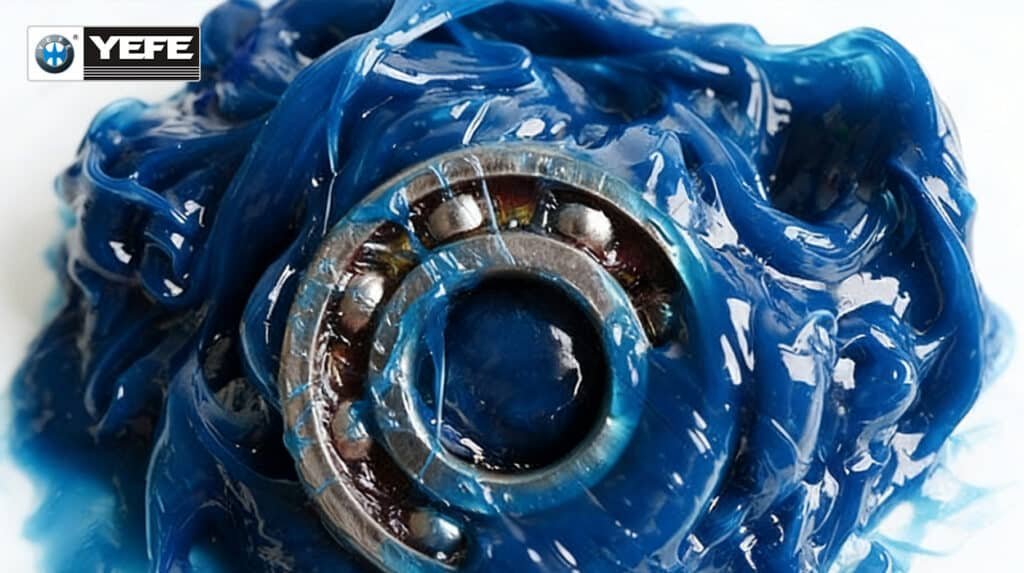
There is no mention of grease and oil being of the same product, they are not of the same principle of lubrication. Grease is also good at retention, sealing and long-periods in contaminated, moderate-speed and hard-to-reach markets. High-speed, high-heat, or circulating systems require active cooling and elimination of contaminants and are dominated by oil.
A decision on which to use between grease and oil must be made with the idea of what each lubricant does in actual working conditions. When equipment is selected properly, it enhances its reliability, lowers the maintenance problems, and eliminates early failures. The type of lubricant should not be compromised with the design, speed, load, environment and duty cycle of the machinery.