
The most important distinction between lithium grease, calcium grease, and complex grease is the systems of their thickeners that affect the temperature potentially, water resistance, and stability directly. The categories of greases are defined mainly by the chemistry of thickener as they are not only the base oil but also by the thickener since it is the chemistry that dictates how the lubricant will act at load, shear, heat, or moisture.
Most users believe that the presence of all general-purpose greases will work equally well when in fact having thickener systems brings substantial functional variations. When selecting the right type of grease, it must be known how lithium, calcium and complex thickeners behave under designated conditions of operations. The possibility of choosing the wrong choice is usually premature wear, leakage, oxidation or total lubrication failure of bearings, gears or even chassis parts.
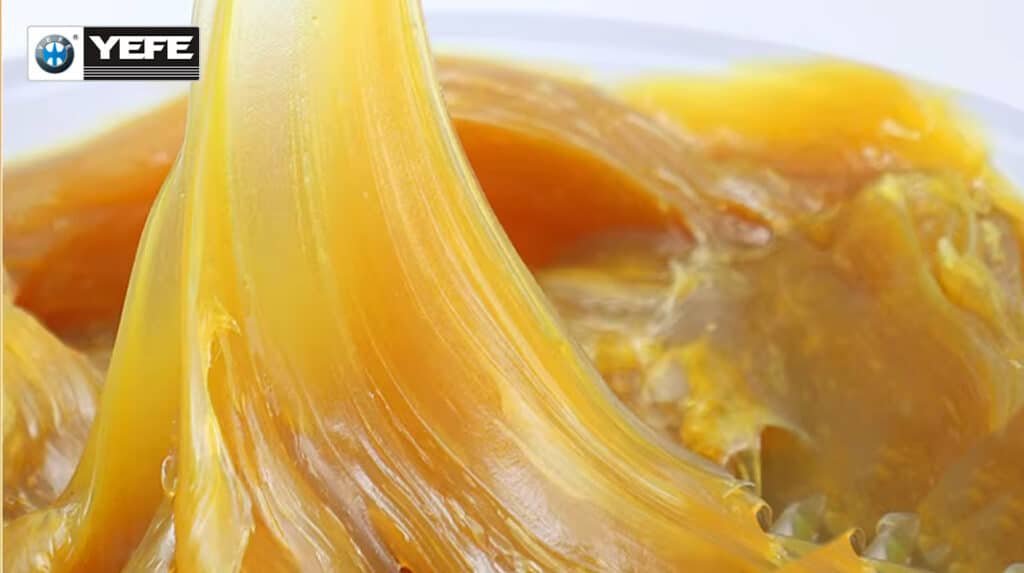
What Defines a Grease Type? Understanding Thickener Systems
The grease type depends on the thickener, which is a 3D network which keeps the base oil and additives in their places until mechanical or thermal stimuli get released, the lubricant being emancipated.
Thickeners Thickeners are normally metallic soaps, which are comprised of a fatty acid (such as 12-hydroxystearic acid) and a metal hydroxide. Simple greases use a single metal, whereas complex greases include a complexing agent (e.g. azelaic acid or boric acid to complex lithium, or special compounds to produce calcium-based complexes) in order to improve the structure and behaviour.
Grease classification is based on the thickener as it controls the crucial properties: dropping point (thermal stability), water washout resistance, mechanical/ shear stability, and corrosion protection.
| Thickener Type | Structural Role | Key Influence |
| Lithium | Simple soap thickener | Balanced performance across moderate conditions |
| Calcium | Simple soap thickener | Superior water resistance |
| Complex (e.g., lithium complex or calcium sulfonate complex) | Soap + complexing agent | High-temperature stability and enhanced durability |
In industry, lithium and calcium based grease are still some of the most popular categories used in industry, although where simple designs are not up to the task, complex recipes are becoming increasingly popular.
Lithium Grease: Characteristics, Advantages, and Limitations
Lithium grease is the general lubrication business standard because it can be trusted in all round usage.
Created using lithium soap (usually lithium 12-hydroxystearate), it has good mechanical stability, an average water resistance and a usable temperature range applicable to most automotive and industrial applications. This is typically at a range of 190 to 200 C of operating temperature, which can be safely operated till around 120 to 130 C, continuous.
Its benefits are superb shear stability (it does not vary in response to mechanical stress), pumpability when used in centralized systems and flexibility in bearings, chassis point and universal joints.
The limitations are seen under extreme conditions: water washout may happen in a very wet environment and long periods of high heat may lead to the separation or sticking of the oil.
| Feature | Lithium Grease |
| Temperature capability | Moderate (up to ~130°C continuous) |
| Water resistance | Moderate |
| Mechanical stability | Good |
| Typical use | Bearings, general equipment, automotive chassis |
Calcium Grease: Water Resistance and Application Scenarios
Calcium grease is distinguished by its high performance in humid and wet conditions, in which the resistance to water is the major issue.
The ancient calcium ample greases (anhydrous or hydrated calcium) create a layer that prevents a wash off, even in salt water or with much hosing. They are also corrosion-resistant in nature and hence appropriate on marine, agricultural, and outdoor equipments.
The main trade-off is reduced temperature potential – leveraging down to 100-150OC can only be used in lower temperature (usually below 80100OC) environments. The structure may metalize at elevated temperature or disintegrate.
This renders calcium grease suitable in use such as chassis lubrication of wet conditions, in water pumps or machinery among other wet and contaminated conditions.
| Feature | Calcium Grease |
| Water resistance | Excellent |
| Temperature capability | Limited (typically <100°C continuous) |
| Corrosion protection | Strong |
| Typical use | Marine, wet environments, outdoor/agricultural equipment |
Complex Grease: High-Temperature and Heavy-Duty Performance

Complex greases add a further complexing agent to the soap structure, which allows thermal stability, load carrying capacity and durability to significantly be increased.
Lithium complex grease is based on the simple lithium and involves the addition of other agents such as azelaic acid, which increase the dropping point to approximately 250260 C and above thus making it possible to operate in a continuous mode at high temperatures. Calcium sulfonate complex greases go even further, frequently surpassing 300 o C dropping points with better inherent water resistance and corrosion protection.
They are superior in high loads, shock or in high heat conditions, and better at oxidizing and have higher service life. They are appropriate in applications that are demanding and simple soaps would soon fail.
| Feature | Complex Grease |
| Dropping point | High (often >250°C) |
| Load resistance | Strong |
| Stability | Excellent |
| Typical use | Heavy-duty, high-temp equipment, industrial bearings, extreme conditions |
Side-by-Side Comparison: Lithium vs Calcium vs Complex Grease
Knowledge of the trade-offs makes it possible to match grease to those on the ground.
| Property | Lithium Grease | Calcium Grease | Complex Grease |
| Water resistance | Medium | High | Medium–High |
| Temperature tolerance | Medium | Low | High |
| Mechanical stability | Good | Moderate | Excellent |
| Typical applications | General equipment, automotive | Wet environments, marine | Heavy-duty, high-temperature systems |
Multipurpose greases have the same benefits, at a higher price, and are not always needed when performing moderately demanding duties.
How to Choose the Right Grease Type for Your Application
The choice of grease has to be based on the real operations condition and not out of habit or availability.
Key considerations include:
- Temperature: Simple lithium is best in moderate temperatures, complex grease in high temperatures (ex: kilns, ovens, or hot-bearing bearings); calcium should be avoided in high temperatures.
- Water or moisture contact: Calcium based greases should be favored when it comes to frequent washdowns, marine or outdoor exposure.
- Load and shock conditions: The complex greases have high film strength and protection on big or shock loads.
- Maintenance time: More stable greases (particularly complex) permit longer relubrication intervals, so that down time is minimized.
It should also be checked to have a review of equipment manuals, OEM recommendations, and environmental factors before making a decision.
Common Mistakes When Selecting Grease Type
The problem of misapplication is still one of the most common reasons of lubrication-related failures.
- Supposing that lithium grease is suitable in all places, it works in a wide range of applications but it cannot work in extreme wet or very high-temperature environments.
- In conditions of high temperature (caused by the use of calcium grease) of the structure, leaking and poor protection occur.
- Unless it is used, don’t bother selecting complex grease that is not necessary in light environments since it is an unnecessary expense.
- Not paying attention to compatibility in equality of switching greases – combining incompatible thickeners (e.g. clay with soap-based etc.) may result in hardening or separating.
Conclusion — Grease Type Selection Is About Application, Not Habit
Knowing the lithium, calcium and complex greases allows one to guarantee the consistency in lubrication and ensures that the equipment is not overused. The thickener system is the determinant of the responsiveness of the grease to temperature, water, load as well as shear which are significant aspects of any maintenance program.
The use of the appropriate grease type is not a matter of convenience or tradition but rather a technical choice depending on the environment, loading and temperature. Applying the same match of the thickener to the requirements of the application will increase component life, minimize failures and enhance the overall equipment reliability.