
The bulk of any finished engine oil is composed of base oils, which generally constitute 70-90 percent of the volume, and to which additives are added to provide the main transport of the additive as well as the essential lubricating properties. They establish the basic properties such as the behavior of viscosity over temperatures, the ability to withstand thermal breakdown and stability over a long duration of use in an engine. Additives improve performance, yet cannot work totally to overcome restrictions which are present in the base oil itself. Most individuals think that the performance of engine oil can be known to be mainly dependent on the additives, and base oil quality is actually the determinant.
Base oil groups have to be known to assess actual performance of engine oil beyond marketing labeling. The selection of base oil groups determines the upper performance limit of an engine oil, way before the considerations of additives. This becomes especially relevant when comparing options across the full range of engine oil grades, where the underlying base stock often explains differences in service life and protection.
What Are Base Oils and Why Do They Matter?
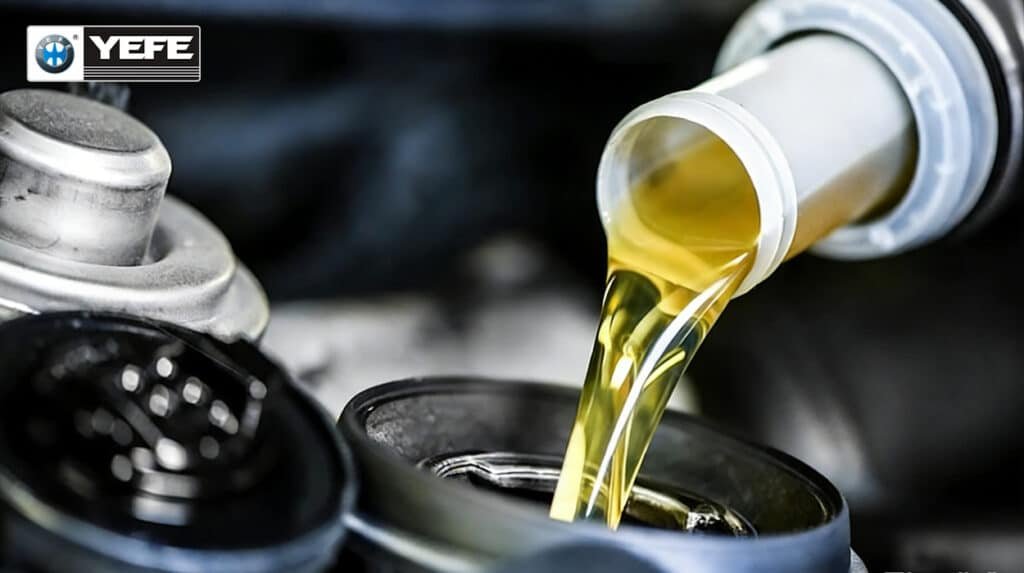
Base oils- Finished lubricants mostly consist of refined hydrocarbon fluids known as base oils. They normally take up 70-90 percent of the formulation in engine oils, with the rest being performance additives and in some instances also a viscosity modifier.
Such fluids perform several vital processes: decreasing friction between moving components, dissipating heat in hot areas, covering combustion gases and preventing corrosion and wear. The intrinsic characteristics of the base oil, (molecular uniformity, purity level, and resistance to oxidation per se.) have a direct effect on the ability of the oil to retain its viscosity either under high shear rates, in extreme temperatures, or during long time usage. Weak base oil can be broken down easily resulting to sludge creation, loss of viscosity or insufficiency of the film strength irrespective of the additive strength.
Overview of Base Oil Group Classification (Group I–V)
To bring uniformity in base stock classification in terms of refining processes and notable chemical characteristics, the American Petroleum Institute (API), came up with the base oil classification system in 1990s to classify these by their percentage of saturates (saturated hydrocarbons), the level of sulfur and the level of viscosity index (VI).
Saturates denote stability in the molecules-higher the saturates the fewer the reactive sites that are likely to be oxidized. A low level of sulfur decreases corrosivity and enhances response to additives. Viscosity index is a measure of the insensitivity of the viscosity of the oil to temperature, the higher the viscosity index, the performance of the oil is in cold start and heat sensitive applications.
The groups are present to assist formulators and users to know anticipated performance levels with the elimination of severity usually enhancing the stability, purity and versatility.
Group I Base Oils — Traditional Mineral Oils
Base oils group I are the least refined of all, created mainly by solvent refining processes, which eliminate some aromatics and some waxes but do not eliminate much impurities.
They have less than 90 percent saturates, over 0.03 percent sulfur and the viscosity index of 80-120. This causes low stability of oxidation, high volatility and more affected by heat degradation than more refined groups. They are also more prone to oxidation leading to increased deposits and darkening.
These base oils are still applicable in lower demanding application like older engine design, industrial gear oil or some greases when cost is more important than the long drain time.
Group II Base Oils — Improved Purity and Stability
Hydrotreating (mild hydrocracking) are done on group II base oils to saturate more molecules, eliminate sulfur and enhance color and stability.
They contain more than 90 percent saturates, under 0.03 percent divider and a viscosity index yet stays in the 80120 variety. The hydroprocessing process has a significant increase of oxidation resistance compared with that of Group I, minimizing sludge and varnish formation, and increasing good low-temperature flow in many instances.
The Group II individual base oils today are prevalent in mainstream passenger car motor oils and numerous industrial lubricants, and these provide a good trade off between performance and cost in typical everyday uses.
Group III Base Oils — Highly Refined and “Synthetic-Equivalent”
Group III base oils are formed as a result of intense hydrocracking with the high-pressure and temperature condition, which produce very high purity rates.
They attain saturates of over 90 percent, and less than 0.03 percent sulphur, with a viscosity index of more than 120, and may easily be much more. This yields brilliant oxidation stability, low volatility and high retention of viscosity at very high and low temperatures.
Due to these characteristics, a great number of formulations including Group III base oils can be labeled in many markets as synthetic, although they are actually based on petroleum crude. This has attracted controversies on the distinction between synthetic and mineral engine oil the difference between synthetic and mineral engine oil. Group III stocks are widely used in premium synthetic-blend and full-synthetic engine oils.
Group IV Base Oils — PAO (Polyalphaolefins)
Group IV base oils are polyalphaolefins (PAOs) which is a genuine synthetic hydrocarbon that has been formed by regulated polymerization of olefins as opposed to refining crude oil.
PAOs provide very high viscosity indexes (typically 130-170 +), outstanding oxidation stability, superior low temperature fluidity and very low volatility. They do not break down easily during heating and retain their film strength at extreme conditions.
These characteristics render PAOs the best choice in high-performance engine oils but their high cost restricts them to costly fully synthetic formulas. To understand more about the combination of such base stocks with additives, see our discussion on PAO and esters.
Group V Base Oils — Esters and Specialty Fluids
Group V also consists of all non-anti-inflammable base oils that cannot be classified using Groups I-IV and which may include polyol esters, diesters, alkylated naphthalenes, phosphate esters as well as certain bio-based fluids.
They have a strong tendency to be polar, highly soluble of additives and compatible with seals because of their chemical structure. The stability of oxidation and viscosity index are also not universal with the specific type, such as ester which has excellent performance at high temperatures and natural lubricity, but is highly priced and hygroscopic.
Group V stocks tend to be seen in minor percentages as performance enhancers, retard in wear or as biodegradable in specific niche formulations.
Base oil groups comparisons comparisons comparison of the key differences between the various groups of Base oil companies.
Comparing Base Oil Groups — Key Differences at a Glance
To summarize the primary performance distinctions:
| Base Oil Group | Oxidation Stability | Viscosity Index | Typical Use |
| Group I | Low | Low (80-120) | Older formulations, basic industrial oils |
| Group II | Moderate | Moderate (80-120) | Mainstream passenger car and heavy-duty oils |
| Group III | High | High (>120) | Synthetic-blend and premium oils |
| Group IV | Very high | Very high (130+) | Full synthetic high-performance oils |
| Group V | Variable | Variable | Specialty enhancement, esters for solvency and seals |
These characteristics help explain why certain oils outperform others in demanding conditions. For more on evaluation methods, explore how base oil categories influence testing results.
How Base Oils Interact With Additives in Formulation
The choice of base oil would have a great impact on the solubility of additives, retention and overall system synergy.
Very paraffinic base oils (such as Group III and IV) may also need alternative dispersant chemistries versus Group I stocks that are more aromatic. The components of Polar Group V increase the additive carrying capacity and inhibit separation and the additives can be consumed more rapidly by the lower-purity bases when it is present in side reactions.
The adequacy model of rigor requires that the base oil should be matched to the additive package otherwise the efficiency will be low or easy to degrade. This interaction is the main part of any strong base oil and additive system.
Choosing the Right Base Oil Group for Performance and Cost Balance
The choice of a base oil group entails the balancing of the performance objectives and expenditure, governmental necessities, and market orientation.
Group II or III often is enough in moderate climates and with normal passenger cars. Group IV or Group V blends may be required due to high-performance or extended-drain applications that require a high thermal and oxidative limit. OEMs (such as API SN Plus, ACEA or ILSAC) often give requirements on minimum base oil quality levels.
Such aspects have to be put into balance by comprehending trade-offs: increased groups will increase the cost of the raw mateials yet can make formulation less complex and enhance performance in the field. Learn more about choosing the right base oil group to balance performance cost and approvals.
Common Misunderstandings About Base Oil Groups
There are still a few myths in the industry:
- Not a synthetic – Group III base oils though made by petroleum, are often considered to be synthetic and legally so in most jurisdictions.
- Higher group, always better oil Group II oil can generally do a certain job in selected cases better than a Group IV that was poorly matched, owing to additive synergy and cost-effectiveness.
- “Additives are replacementary of base oil quality” — Additives are complementary but are not regulatory of base oil restrictions in oxidation poorness, volatility or shear steadiness.
Conclusion — Base Oils Define the Ceiling of Engine Oil Performance

The base oil sets the maximum performance that can be targeted in the engines such as thermal stability, ability to control volatility as well as long life in engine oil formulation. Although additives are an important supporting factor, the natural chemistry of the base stock determines the effectiveness of the lubricant to overcome the stresses of reality in engines.
Formulators choose, and combine the base oil groupings in a way that becomes strategic to achieve certain performance, cost and regulatory objectives. This base-oil-first methodology is the one that has allowed the formation of a solid lubricant development strategy, which is why further deliberations on testing conditions and trans-urban formulation approaches can take place.