
Grease is composed of a base oil, thickener and additives and it is a semi-solid lubricant. Depending on the design of the lubrication and its delivery system, grease formulations contain liquid lubricating oils that flow through and circulate through the system unlike grease based lubrication which functions to stay at the lubrication point to release oil over time as the lubricated component moves under mechanical loads to sustain a protective coat.
Most individuals view grease in a misleading way as a thicker oil. As a matter of fact, it is a well-organized lubrication system having its definite mechanical functions. Grease is used as a way to maintain lubricating oil suspended in a thickener matrix which can release oil on demand, and remain stable under loads, vibration, and heated conditions. This feature renders it quite useful in applications where oil would run out or fail to offer long-term protection.
This knowledge helps maintain workers and engineers to choose an appropriate lubricant to use to maintain good working equipment.
What Is Grease Made Of? Understanding Its Core Components
The whole aspect of grease performance can be attributed to the three main constituents extending to the base oil, thickener, and additives interrelating in a balanced way to create performance.
The main lubricating component is base oil, which forms the semi-solid structure and is produced by thickener, and additives are added to add certain properties. The balance of temperature does not simply increase the thickness of the grease in fundum, but proper formulation balance has an influence upon the effectiveness of the grease under real-life conditions.
| Component | Function | Why It Matters |
| Base oil | Primary lubricating element | Determines viscosity, film strength, and overall lubrication capability |
| Thickener | Holds oil in place | Enables grease to stay where applied and resist flow under gravity or motion |
| Additives | Enhance performance | Improves wear resistance, corrosion protection, oxidation stability, and more |
The actual lubrication is usually 70 95 percent of the grease and is the base oil. The thickener is usually a metallic soap or non-soap substance and this is created as fibrous or sponge-like structure, on which the oil is held. The trimmings, though in lesser quantities, are designed to cater to purpose needs like waterproof or extreme pressure. The lack of balance in these aspects may result in inadequate shear stability, excessive oil separation, or inadequate protection.
How Grease Works in Mechanical Lubrication Systems
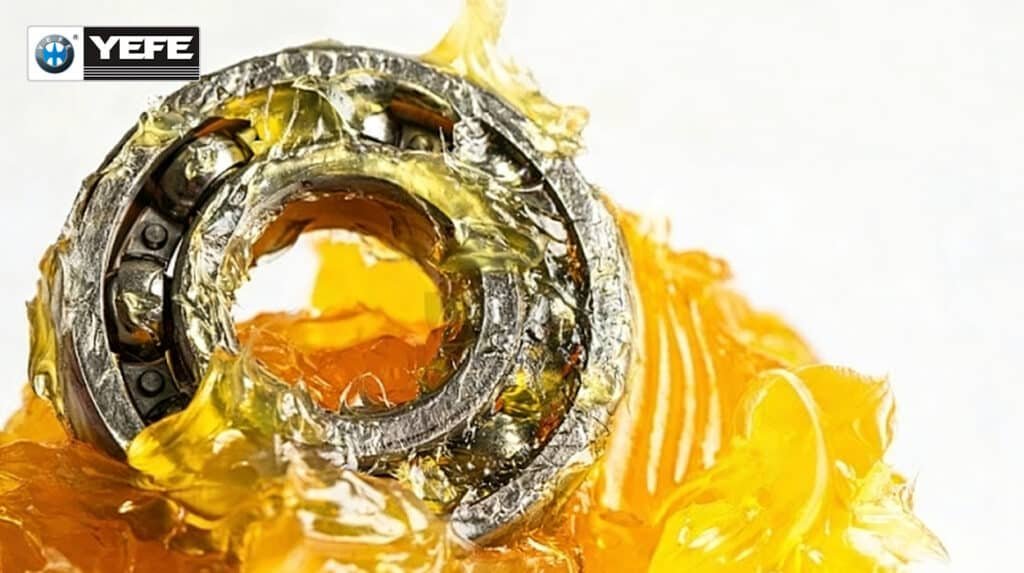
Grease acts as a storage of lubricating substance which can be operated dynamically in regard to the functioning conditions, in releasing oils where necessary and positioning itself the rest of the time.
When subjected to mechanical stress, like shear, by moving parts, the thickener matrix expands slightly to allow quantity of base oil to bleed out creating a thin film of lubricating oil that forms between the surfaces. The pressure drops and the structure reforms holding on to the rest of the oil. This self controlling mechanism can remove the use of continuous circulation means commonly used in oil lubrication.
| Operating Condition | How Grease Responds | Functional Benefit |
| Load pressure | Oil bleeds from thickener | Prevents metal-to-metal contact |
| Vibration | Grease remains in place | Reduces lubricant loss and migration |
| Idle periods | Grease does not drain or flow away | Provides long-term protection during shutdowns |
This is the reason the grease is operative in closed or difficult to access spots that provide regular lubrication without having to add it frequently.
Grease vs Oil: Why Grease Is Used Where Oil Cannot
Both grease and oil have the effects of reducing friction and wear; however, due to physical characteristics they exhibit, there are radically different behaviors exhibited in mechanical systems.
Oil is free-flowing, hence is suitable when rapid replenishment and heat dissipation is important in the system with the use of pumps, filters, and sumps. Grease on the contrary remains in situ, as a lubricant and a barrier. It is this retention and sealing property which makes grease the choice of application in most strenuous conditions.
| Factor | Grease | Oil |
| Consistency | Semi-solid | Liquid |
| Retention | Stays in place | Flows freely and can drain |
| Sealing ability | Acts as a seal against contaminants | Limited unless contained in a closed system |
| Maintenance | Longer intervals between applications | Frequent replenishment often required |
Grease offers long-lasting protection in the bearings, chassis joints and closed-type gearboxes when there is sustained protection under heavy loads or when the bearings operate intermittently, and the oil may leave the area of contact. To learn more about industrial grease that would be applicable in these circumstances, go to our specific category.
Common Applications Where Grease Is Essential
Grease is essential when it comes to high loads, contact with contaminants or when it is generally inaccessible to be relubricated.
Its staying capacity and ability to fight washout or migration is a welcome improvement to its use in a wide range of industries.
| Application | Why Grease Is Used |
| Bearings | Long-term lubrication and sealing in rolling elements |
| Heavy equipment | High load and shock resistance in pins and bushings |
| Marine environments | Water resistance to prevent corrosion and washout |
| Construction machinery | Dust and contamination protection in harsh field conditions |
Such applications indicate the application of grease in increasing the life span of components in the scenario where liquid lubricants would not be feasible.
Key Properties That Define Grease Performance
The choice of the grease involves consideration of properties that have a direct relationship to its suitability in particular operating environment.
Other important parameters are consistency, thermal stability and resistance to environmental factors.
| Property | What It Indicates |
| NLGI grade | Consistency and pumpability (0–6 scale; 2 is most common) |
| Dropping point | High-temperature stability (temperature at which structure breaks down) |
| Load resistance | Wear protection capability under extreme pressure |
| Water resistance | Suitability for wet or humid environments |
The NLGI grade is a depth of penetration that is used to categorize the softness or firmness that influences the pumpability and channelling. Dropping point indicates the maximum limit of the thickener holding oil but maximum operating temperature is usually below this point. Additives such as load carrying and water-washout resistance further refine performance in accordance with actual requirements.
Why Understanding Grease Fundamentals Matters Before Selection
The problem of misapplication of grease is usually due to the underestimation of the interaction with the structure and behaviour of the grease with the needs of machineries.
Treating any grease as it is used all the time does not take into account all the important variables such as load, speed, temperature and the environment. The incompatibility of types may result in softening, hardening, or chemical degradation, which will result in a rapid wear or failure. Thickener compatibility, load and speed ratings and operation conditions should be used to make decisions that will ensure the optimal protection and efficiency.
Common Misconceptions About Grease
There are a number of common misconceptions that may result in inefficient processes of lubrication.
- Once it is applied Grease is permanent, but it degenerates with usage Grease is oxidized, contaminated, subjected to mechanical shear and thermal extremes; it needs regular inspections and replenishment.
- Grease, regardless of place of origin, is always much more protective when thicker – An increase in consistency (is the stiffer NLGI grade) does not necessarily correspond with an increase in performance; it will work differently in different real-world situations.
- Any greases can be mixed – It is possible to ruin the structure, leak or lose effectiveness of different types of thickeners (e.g., lithium and calcium) by mixing.
- The terms grease and oil may be used interchangeably -the retention and flow characteristics that the two possess allow them to be used in different systems; the risk associated with replacing one with the other is insufficient lubrication.
Conclusion — Grease Is a Functional Lubrication System, Not Just a Material

Grease is not just an oily variant of oil. Its thickener network allows its oils to be dischargeable, position retentive, and sealing, which liquid lubricants are not able to imitate in quite a number of situations.
The first step to the efficiency of using grease is to know how it differs in the conditions of actual use and why it is not oil. The knowledge will help engineers and maintenance managers to make wise choices to have quality equipment performance and prolonged component life.